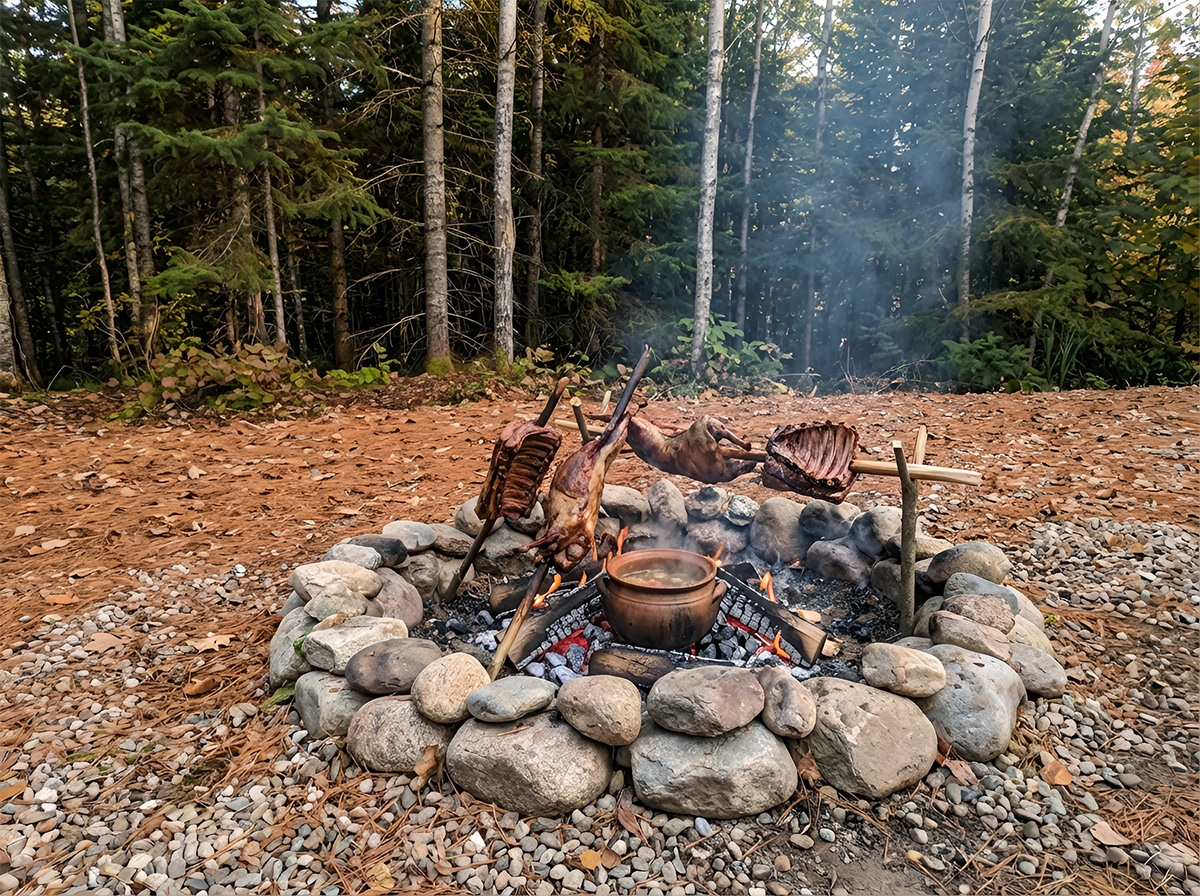
Cooking the Paleolithic Way
At Serranova, we prepare meals the way humans did for over 200,000 years—no metal, no modern cookware; just fire, stone, water, and skill.
Roasting techniques
The most fundamental cooking method. Skewer meat on wooden spits and rotate over open flames. Place fish or smaller cuts directly on hot coals. Wrap food in large leaves and bury in hot ashes for slow-roasting. Make your own stone fire circles across the property provide personal cooking spots, while our three large bonfire rings are for group gatherings and communal meals.
Hot Stone Cooking
How do you boil water without a metal pot? The same way our ancestors did: with fire-heated rocks. Select dense, dry stones (wet or porous rocks can explode—see paragraph below). Basalt is a dense, food-grade stone. Unlike porous stones, it does not easily explode when heated. Never use wet or porous rocks, as they can explode when the internal moisture turns to steam. Heat them in your fire until glowing. Using wooden tongs or green sticks, transfer the hot stones into water held in a hide-lined pit, a tightly woven basket, a carved wooden trough, or even a cleaned animal stomach. The stones release their heat into the water, bringing it to a boil within minutes. Keep adding fresh hot stones to maintain temperature. It’s surprisingly effective—and deeply satisfying to make your first hot stone stew.
About stones and heat: For the safest cooking, use dense, dry basalt, or use granite slabs as griddles by heating them on the edge of the fire to prevent cracking. Avoid slate and any stones found near water, as trapped moisture and layered structures make them highly susceptible to dangerous explosions when heated. Slate is the rock most likely to explode or “spit” sharp fragments when heated in a fire. Basalt is a volcanic rock that is much denser and more fine-grained than granite. It is extremely tough and handles rapid temperature changes better than granite does. A 12″ x 16″ cooking stone can cost $120 on Etsy.
The baskets used for hot stone cooking are tightly woven from plant fibers—and everything we need grows right here in Maine. Brown ash, the traditional material of Wabanaki basketry, grows in swampy lowlands. Sweetgrass can be gathered from coastal salt marshes. Willow and cattail thrive along streams and wetlands. White pine needles work for coiled baskets. Even grapevine and honeysuckle can be woven into functional vessels. When woven tightly and kept wet, these baskets hold water long enough for hot stones to do their work. Learning to identify, harvest, and weave these materials is part of the Serranova experience—connecting you to the land beneath your feet.
Earth Ovens
Dig a pit. Line it with fire-heated rocks. Add your food—meat, root vegetables, tubers, wrapped in maple leaves. Cover with more leaves, then earth. Go do something else now… hours later, return to perfectly slow-cooked food, tender and infused with smoky flavor. Earth ovens are the original slow cookers, and they work well for feeding groups at festivals and gatherings.
Depth: Dig the pit roughly 18–24 inches deep (about knee-deep) to allow enough space for a thick base of stones, multiple layers of food, and a heavy insulating layer of earth on top.
Preheating: Fire your stones for at least 1–2 hours before placing them in the pit; they should be “white-hot” or glowing to ensure they hold enough thermal energy to cook through the night.
Steam Generation: Use damp, green vegetation—such as ferns or large maple leaves—to wrap the food; the moisture in the leaves creates the steam necessary to tenderize tough wild game and fibrous tubers.
Timing: small portions may take only a few hours. Larger communal meals are best left overnight to allow the steady, receding heat to break down connective tissues.
Stone Slab Griddles
Flat rocks heated in the fire become natural griddles. Use them to cook fish, thin-sliced meat, or simple flatbreads made from foraged or bartered grains and ground acorns. The stone holds heat evenly and imparts a faint earthy flavor you won’t find in a modern kitchen. Food-grade stones include basalt. See above–never use slate stones!
Primitive Clay Pottery
While pottery technically emerged later in human history (Neolithic era, around 10,000 BCE), you can learn to make handmade, hand-fired clay pots. It’s possible to source local clay, shape vessels by hand, and fire them in open pits. Once you’ve made your own cooking pot, use it for simmering stews, heating water, and storing foods. This may have less yuck-factor than cooking in animal stomachs.
Smoking and Drying
Preserve meat and fish by building simple wooden racks over smoky fires. Smoking not only extends the life of your food but adds rich flavor. Learn which woods create the best smoke, how to control temperature, and how our ancestors stored protein for lean times. Hardwoods like oak, maple, and hickory produce strong, long-lasting smoke ideal for red meat and fish; fruit woods like apple and cherry give a milder, sweeter flavor perfect for poultry and pork. Avoid softwoods like pine or spruce—their resin creates bitter, sooty smoke.
The Experience
Primitive cooking is slower. It requires more attention, more hands-on engagement, more presence. Most often you can’t set a timer and walk away (except for earth ovens). You watch the flames, tend the coals, rotate the spit, test the stones. And when you finally eat what you’ve prepared—meat you roasted on a wooden spit, stew you boiled with hot stones, bread you baked on a hot rock—it tastes different in a way you won’t believe.
This is food the way humans experienced it for most of our existence. No appliances, no microwaves, just fire, patience, and the deep satisfaction of feeding yourself with your own hands.
Fyi, modern “Paleo diets” often include avocados, broccoli, potatoes, tomatoes, peppers, modern grains, and almonds. But these are products of thousands of years of selective breeding. If we want to be accurate, there are wild-type equivalents: bitter greens, small tubers, seasonal berries; wild herbs (wild garlic, fennel), nuts (acorns, hazelnuts), berries, and “whole animal” cooking (marrow, organ meats).
What We Provide
Serranova supplies all the seasoned firewood you need (less smoke than fresh-cut wood) and drinking water. And we have refrigeration in the three cottages and in the barn’s kitchen. Note that Maine law prohibits bringing firewood from outside the state. Everything else—the skills, meat and plants, the patience, the satisfaction of cooking without modern conveniences—you develop yourself, with help from fellow members and community workshops.
Serranova will source fresh raw meat and vegetables for members to buy and cook with. Hunting and gathering can be fun, and there will be small game, but realistically, we’ll provide food from local farms to meet in the middle.
Free workshops at Serranova will cover fire-making, hot stone cooking, earth ovens, clay pottery, and more. Experienced members can teach newcomers. Come to learn—leave knowing how to feed yourself the way your ancestors did.
Be sure to check our ground rules about game and meat processing.